
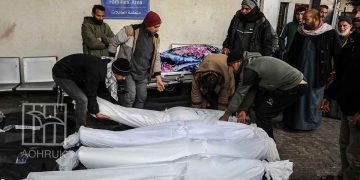



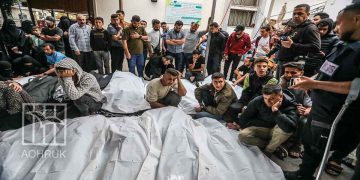


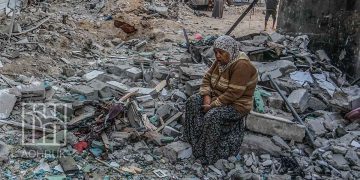

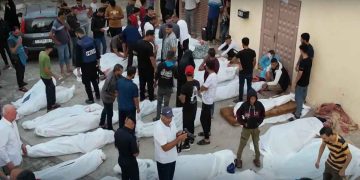







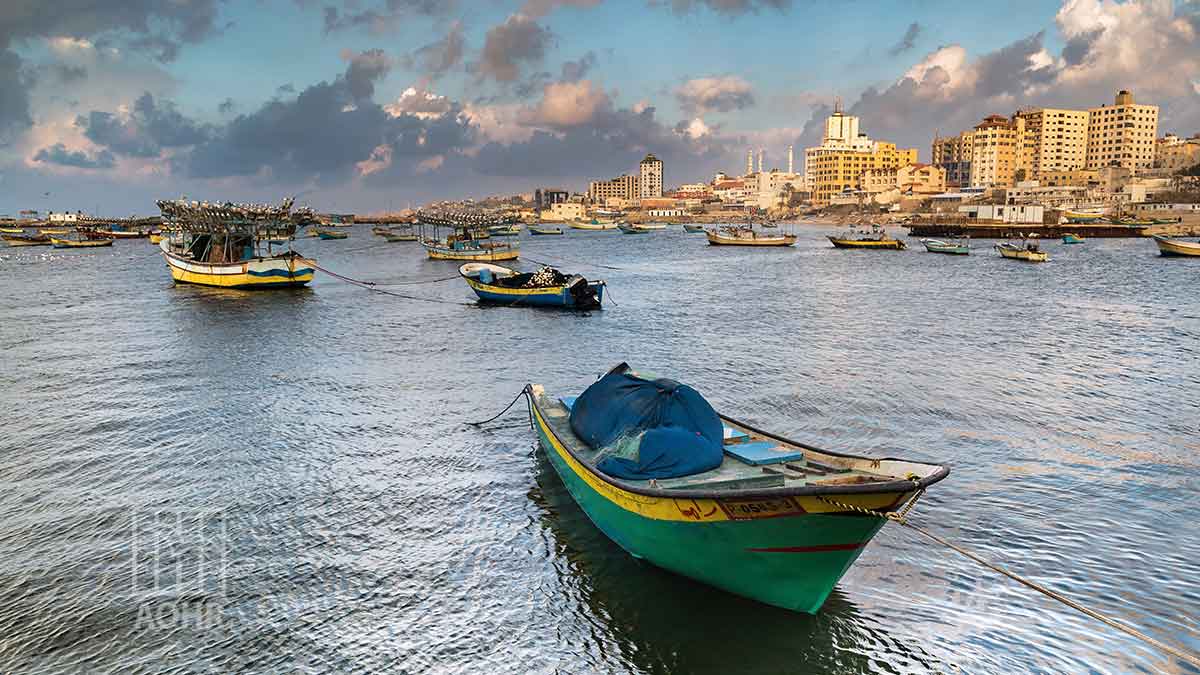
The sea in the Gaza Strip is no longer a source of livelihood or a space for life. It has become an exposed arena for direct targeting, where Palestinian fishermen face the risk of death simply for trying to secure food for their families.
Between severe restrictions, a complete ban on fishing, and repeated live fire at small boats, the growing number of fishermen killed reflects another dimension of the ongoing genocidal war against Gaza — one that reaches into the most basic details of daily civilian life.
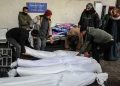
On Sunday, a Palestinian fisherman died from critical injuries sustained in the waters off Khan Younis, in the southern Gaza Strip, after Israeli occupation naval boats opened fire on a group of fishermen working close to the shore. Another fisherman was wounded in the same attack.
According to Zakaria Bakr, Coordinator of the Palestinian Fishermen’s Committees at the Union of Agricultural Work Committees, the fisherman Abdul Rahman Abdul Hadi al-Qan succumbed to severe gunshot wounds sustained while fishing west of Khan Younis.
Bakr stated that since the ceasefire came into effect, ongoing attacks have resulted in the killing of two fishermen, in addition to drowning incidents involving others after their small fishing boats (hasakat) capsized under dangerous maritime conditions created by the ban and restrictions. During the same period, 28 fishermen were arrested.
He added that the total number of fishermen killed since the start of the genocidal war on the Gaza Strip has reached 232, including 67 fishermen who were killed while attempting to fish at sea as a result of the direct targeting of their boats and gunfire opened against them.
Despite the announcement of a ceasefire, fishermen affirm that the occupation continues to completely prohibit access to the sea, in clear violation of the agreement. This forces them to operate in extremely close and hazardous areas in desperate attempts to secure the bare minimum for survival.
The targeting of Palestinian fishermen at sea constitutes a clear violation of international humanitarian law, particularly the principle of protecting civilians and their means of livelihood during armed conflicts. Fishermen are civilians not taking part in hostilities, and their small boats are civilian livelihood tools that must not be targeted or disabled.
The ban on fishing and the complete closure of the sea also amount to collective punishment, which is prohibited under international law, and are used as tools of economic pressure and starvation by depriving thousands of families of their sole source of income.
Repeated incidents demonstrate that what fishermen are subjected to is not the result of isolated mistakes or exceptional circumstances, but rather part of a systematic policy aimed at economically strangling the Gaza Strip and entrenching conditions of enforced deprivation — even during declared periods of de-escalation. Continuous targeting, total prohibition, pursuits, and arrests are all employed to empty the sea of fishermen and turn it into a forcibly imposed exclusion zone.
As these violations persist, Gaza’s fishermen continue to pay a heavy price simply for insisting on their right to work and to live. In the absence of any effective protection, the sea remains a stark witness to one of the harshest forms of abuse — where a civilian is killed for trying to survive, and besieged because he has not yet died of hunger.