







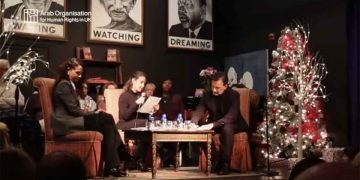


“Busboys and Poets” hosted a major public event on Sunday titled “Holding Israel Accountable: Craig Mokhiber and Noura Erakat in Conversation with Katie Halper,” held at the 14th & V venue in Washington, DC. The discussion brought together former UN official Craig Mokhiber and legal scholar Noura Erakat, under the moderation of journalist Katie Halper, to examine Israel’s ongoing atrocities in Gaza and the mechanisms that allow the state to evade accountability.
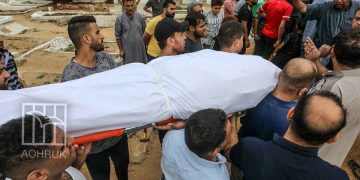
The event took place amid growing international demands to confront what participants repeatedly described as a genocide unfolding in real time, and in the context of mounting frustration over the paralysis of global institutions tasked with upholding international law.
Throughout the discussion, Craig Mokhiber delivered a stark assessment of the situation in Gaza, emphasising that Israel’s actions meet the legal threshold of genocide, with both genocidal intent and genocidal acts clearly demonstrated in evidence presented before the International Court of Justice. Mokhiber argued that Israel has failed to mount any meaningful legal defence, relying instead on political messaging aimed at Western audiences.
He sharply condemned UN Security Council Resolution 2803, calling it “the greatest betrayal of the Palestinian people in decades.” According to Mokhiber, the resolution was engineered to halt the growing international momentum toward holding Israel accountable before international courts. He warned that the credibility of the global legal system is collapsing as Israel continues to be treated as a state effectively above the law, shielded by the political influence of powerful allies.
Mokhiber further argued that the ideology underpinning the state—Zionism—operates as a racist and colonial framework that must be confronted directly, asserting that any political solution that preserves Zionist supremacy cannot lead to justice or stability. He also highlighted the shrinking space for free expression within the United States, where he said the First Amendment is being “emptied of substance” to protect Israel from criticism, resulting in the surveillance, harassment, and suppression of activists, scholars, students, and journalists.
For her part, Noura Erakat offered a detailed legal analysis explaining how the international legal system has been historically shaped to create a permanent exception for Israel, beginning from the British Mandate period. She argued that this exception—often framed as sui generis—has allowed Israel to operate outside the standards applied to all other states, effectively enabling systematic violations without consequence.
Erakat stressed that Zionism must be named accurately as a settler-colonial and racial project, insisting that avoiding precise terminology obscures the underlying structure of domination. She called for the reclamation of Palestinian legal vocabulary—including the Nakba as an ongoing crime—rather than relying solely on borrowed frameworks such as apartheid or genocide, even though these terms also apply.
She also underscored the central role of private corporations in enabling Israel’s assault on Gaza, describing it as the first “globalised genocide” in which multinational companies across the world play active operational and logistical roles. Holding these corporations accountable, she argued, is essential to creating real political and economic pressure.
Erakat emphasised that legal strategies alone cannot produce justice, asserting that law follows political power, not the other way around. Real accountability, she said, requires synchronising legal action with organised popular movements capable of confronting the political forces that maintain Israel’s impunity.
The event concluded with a shared assessment from both speakers that the current moment represents a critical turning point. They argued that advancing justice for Palestinians depends on dismantling the legal and political structures that grant Israel its exceptional status, and on mobilising sustained public and institutional pressure to confront the deep-rooted systems enabling the ongoing genocide in Gaza.