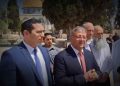












The Israeli occupation government’s minister Itamar Ben-Gvir stormed Ofer Prison near the city of Ramallah in the occupied West Bank, amid abusive measures against Palestinian detainees. These included the detonation of stun grenades in front of prison cells and applying more restrictions on prisoners as the holy month of Ramadan approaches.
This action is part of a policy announced by Ben-Gvir since assuming office in late 2022, based on intensifying harsh detention conditions inside prisons. According to repeated testimonies from released detainees, this policy has led to a marked deterioration in living and health conditions inside prison sections, with growing signs of malnutrition, medical neglect, and sustained psychological pressure.
The minister has also consistently published videos and statements widely regarded as inciting and degrading towards detainees, threatening to expand punitive measures and push for even more stringent legislation.
In principle, the conditions of detainees in occupied territories are governed by firmly established rules of international humanitarian law, most notably the Geneva Conventions, which obligate the occupying power to guarantee humane treatment of detainees, prohibit torture and cruel or degrading treatment, and ensure access to healthcare, adequate food, and regulated contact with the outside world.
Global human rights standards likewise affirm the right of every detainee to dignity and to physical and psychological integrity, regardless of the charges brought against them.
In this context, collective punitive measures or systematic tightening of conditions inside prisons constitute practices that run counter to the principle of proportionality and the obligation to respect human dignity, particularly when they affect vulnerable groups such as children, the sick, or the elderly. The legal gravity is compounded when such measures are accompanied by political rhetoric calling for harsher and more extreme punishments, as this creates an environment conducive to the expansion or justification of further violations.
The Israeli Knesset has recently voted in favour of a draft law expanding the scope of the death penalty reflecting the occupation’s determination to escalate legalised terror against Palestinian detainees, flagrantly violate the right to life, and undermine any prospect of a fair trial.
The synchronisation of this legislative trajectory with policies of abuse inside prisons reflects a systematic strategy aimed at destroying detainees’ dignity and stripping them of their most basic rights, rendering compliance with international humanitarian law an urgent and decisive necessity in confronting the occupation’s ongoing crimes.