






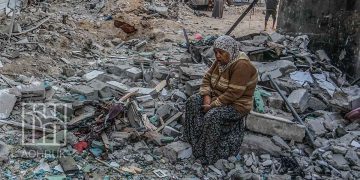








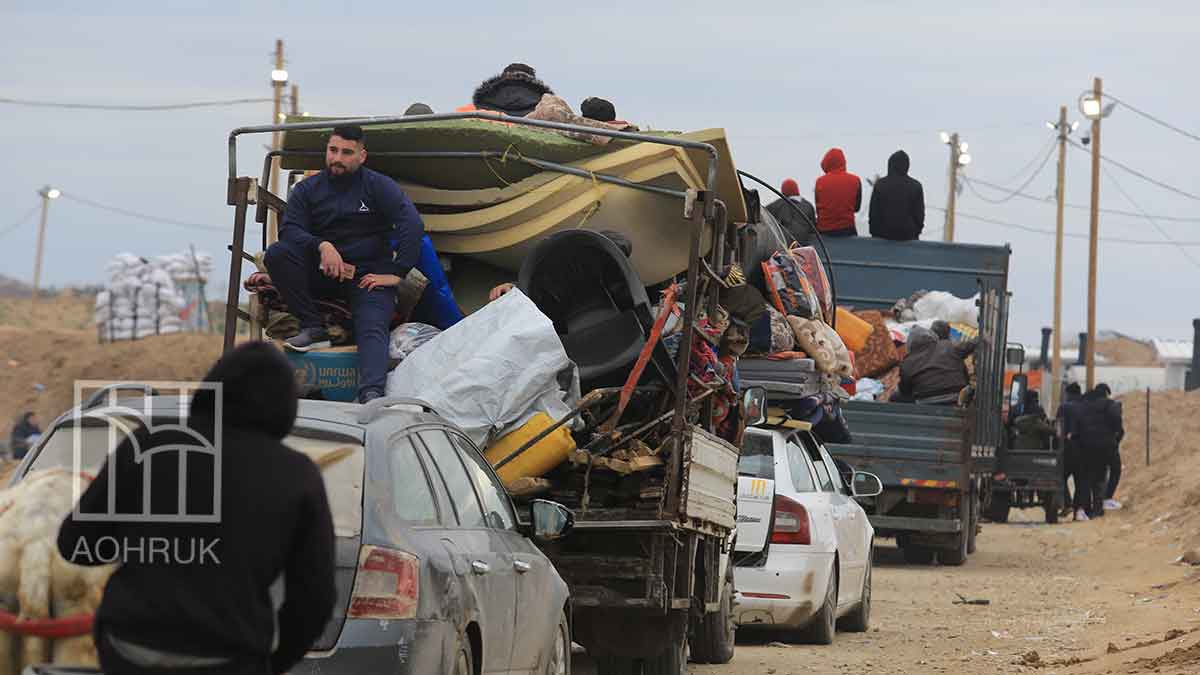
Policies of forced displacement continue across the West Bank, as Israeli occupation authorities issued a military order on Sunday morning mandating the evacuation of a Bedouin community in the town of Al-Mughayyir, east of Ramallah. The move reflects a recurring pattern of field measures aimed at undermining Palestinian presence in small, isolated pastoral communities.
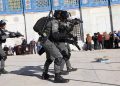
Israeli occupation forces raided the Abu Najeh al-Ka’abneh Bedouin community in the Al-Khalayel area south of Al-Mughayyir and handed residents—around 40 people—orders requiring them to leave the area within 48 hours, after declaring it a “closed military zone”. During the raid, occupation forces also detained three foreign solidarity activists of different nationalities who were present at the site, before withdrawing.
This incident comes amid a prolonged series of evacuations targeting Bedouin and pastoral communities across various parts of the Jordan Valley and the eastern West Bank. Of particular note is what occurred in the Shallal al-Auja community north of Jericho, where the displacement of all Palestinian families—approximately 120 families—has now been completed after years of sustained pressure.
The displacement there did not occur at once, but through gradual stages involving the restriction of livelihoods, limitations on grazing, repeated incursions, and the creation of a coercive environment that compelled families to leave one after another, until the area was emptied of its original inhabitants.
Under well-established principles of international humanitarian law, forced displacement constitutes a serious violation of the rights of populations living under occupation, including the rights to housing, personal security, and freedom of movement. International conventions prohibit the forcible transfer of civilians or coercing them to leave their places of residence, whether directly or through systematic policies that effectively lead to the same outcome.
Relevant legal principles also affirm that declaring areas “closed military zones” does not justify the permanent evacuation of civilian populations. Legal responsibility extends beyond direct acts to include policies that create unlivable conditions forcing people to leave. Protecting Bedouin and pastoral communities forms part of safeguarding traditional ways of life, property rights, and lawful access to land.
The impact of displacement extends beyond the loss of shelter to the dismantling of social ties and the destruction of livelihoods—particularly in Bedouin communities that depend on herding and seasonal movement. The uprooting of families also disrupts children’s education, undermines access to healthcare, and deepens economic vulnerability, creating a cycle of persistent instability.
Field evidence indicates that phased evacuations, coupled with short notice orders and repeated raids, generate prolonged psychological and social pressure, turning daily life into a state of constant uncertainty. This reality falls below minimum standards of human dignity and safe living.
Taken together, the events in Al-Mughayyir and Shallal al-Auja reflect an escalating course of measures that strike at the core of civilians’ fundamental rights, raising serious questions about the occupying power’s obligations under international law and its adherence to guarantees that protect communities’ right to remain on their land without coercion or threat.