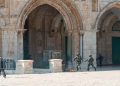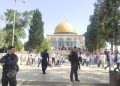
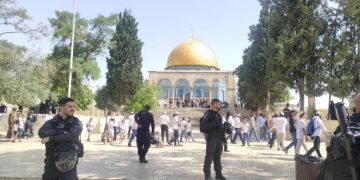
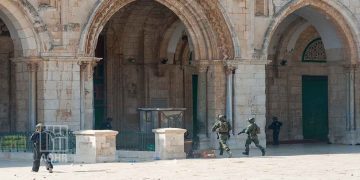









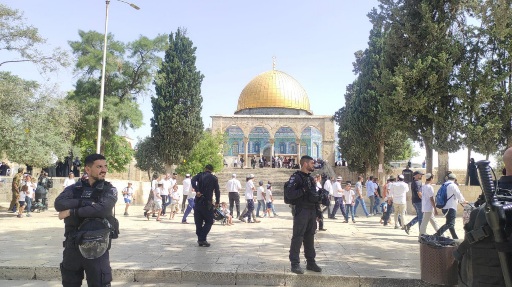
The Israeli occupation authorities continue to close the Al-Aqsa Mosque in occupied Jerusalem for the 20th consecutive day, preventing worshippers from accessing it under the pretext of security concerns related to the US-Israeli war on Iran.
With the continued closure of Al-Aqsa, hundreds of thousands of Palestinians will be prevented from performing Eid al-Fitr prayers there tomorrow, in what has been described as an unprecedented move.
This closure is considered arbitrary and unjustified, as the Al-Aqsa Mosque has not witnessed a complete closure during Ramadan since 1967, nor has it been completely prevented from performing religious rites in this manner.
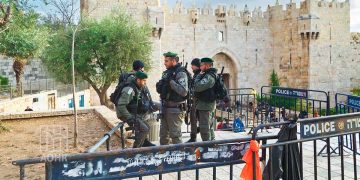
The occupation forces had previously prevented citizens from performing Taraweeh prayers in several neighborhoods of the city, deployed around Damascus Gate and Herod’s Gate, and forced worshippers to leave the area in an attempt to disperse them and prevent any gatherings for prayer.
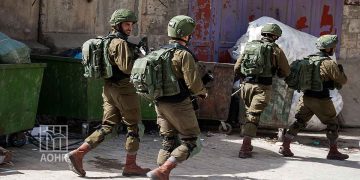
This comes amid a heavy military presence around the Al-Aqsa Mosque and the Old City, where occupation forces are imposing strict movement restrictions, closing several gates, and preventing gatherings. The measures have also affected Waqf (Islamic endowment) employees, with a reduction in the number of those permitted entry, impacting the daily management of the mosque.
Despite the closure, Jerusalemites continue to flock to the vicinity of Al-Aqsa and its gates, performing prayers in the streets and on the steps for consecutive nights. This reflects popular rejection of the imposed restrictions, especially as they have been extended to nearby areas such as the Rashidiya School square.
The measures have also spread to various neighborhoods in Jerusalem, where congregational prayers, including Taraweeh prayers during the last ten days of Ramadan, have been prohibited. A significant military presence is also observed around the gates of the Old City, and any religious gatherings are banned.
The closure of places of worship and the prevention of access to them constitute a blatant violation of freedom of worship and cannot be justified under the pretext of general security, especially when applied comprehensively and targeting a specific segment of the population. The denial of access to religious sites for hundreds of thousands of worshippers, particularly during a major religious occasion, reflects a systematic policy of restriction and warrants accountability as a grave violation of fundamental rights.
This closure comes within a broader context of escalating restrictions, coinciding with a comprehensive closure of the West Bank, heightened regional tensions, and warnings of growing calls by settler groups to alter the status quo at the Al-Aqsa Mosque.