












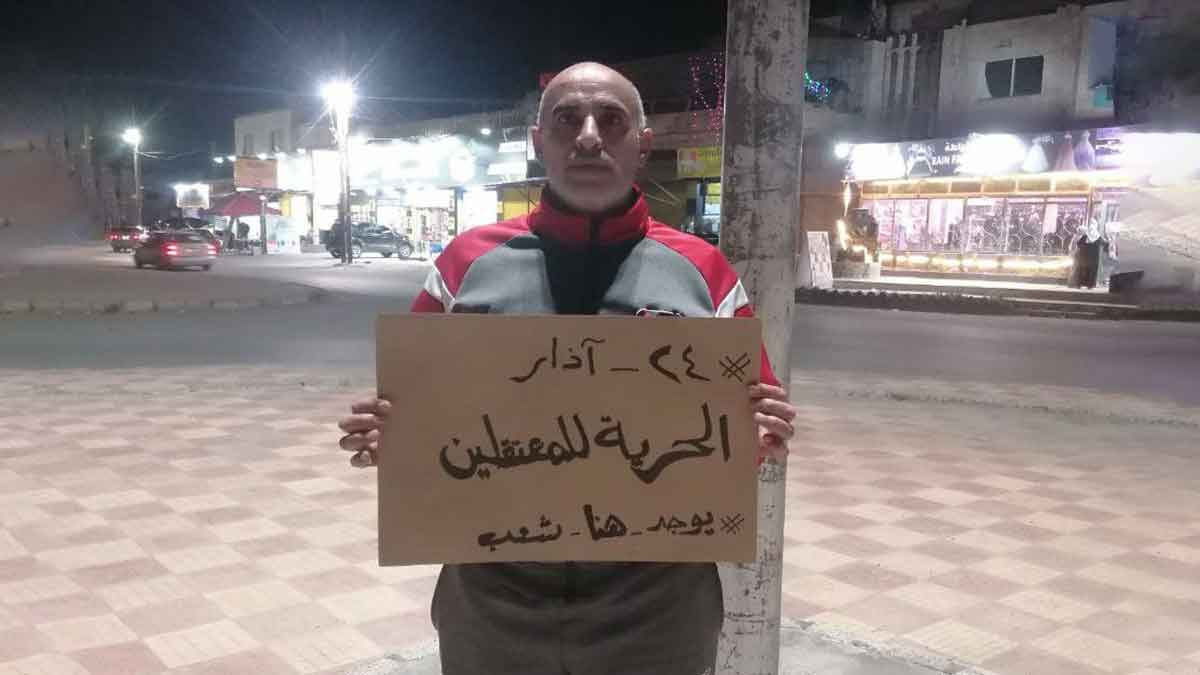
Jordanian security services have arrested political activist Tayseer Al-Amoush, in preparation for referring him to the Cybercrime Unit, in connection with his political activity and his repeated public discussion of the case of his detained relative, engineer Daham Al-Amoush, who is facing a critical health condition following mysterious circumstances surrounding his period of detention.
His family reported a serious decline in his condition after he was transferred to Al-Bashir Hospital in the capital, Amman, where he was admitted to the intensive care unit several months ago. He has since remained in a coma as a result of septic shock, and continues in this state to the present time.
According to the detainee’s family, his admission to intensive care followed a sudden deterioration in his health caused by a hunger strike, amid fears of complications that could extend to neurological functions, in the context of what the family describe as ambiguity surrounding the circumstances of his decline while in custody.
These developments raise a series of legal questions concerning the guarantees of freedom of expression and the limits of prosecution for digital political activity. Constitutional principles and international covenants enshrine the right of individuals to express their opinions, provided such expression does not entail direct incitement to violence or hatred. At the same time, the authorities bear a responsibility to ensure a genuine balance between the requirements of law enforcement and the protection of citizens’ fundamental rights.
On the humanitarian level, the deterioration of a detainee’s health while in custody places a direct responsibility on the state for his physical and psychological safety. This includes providing urgent and appropriate medical care, and guaranteeing the family’s right to timely access to health-related information. The right to medical treatment is an integral component of the right to life and human dignity, and does not lapse by virtue of detention.
Human rights jurisprudence further indicates that hunger strikes are often regarded as an extreme form of protest, reflecting a sense of blocked avenues for grievance and redress. This reality necessitates periodic review of detention procedures, the activation of independent oversight mechanisms, and enhanced transparency in the management of medical files within places of detention.
In sum, the case reveals a sensitive intersection between freedom of political activity, the authority of legal prosecution, and the humanitarian duty to safeguard the lives of detainees, in an intersection that once again underscores the need to establish a genuine balance between the imperatives of public security and the protection of basic rights and freedoms.