




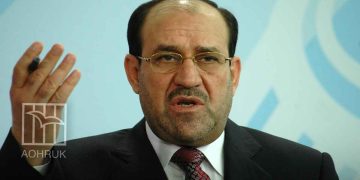








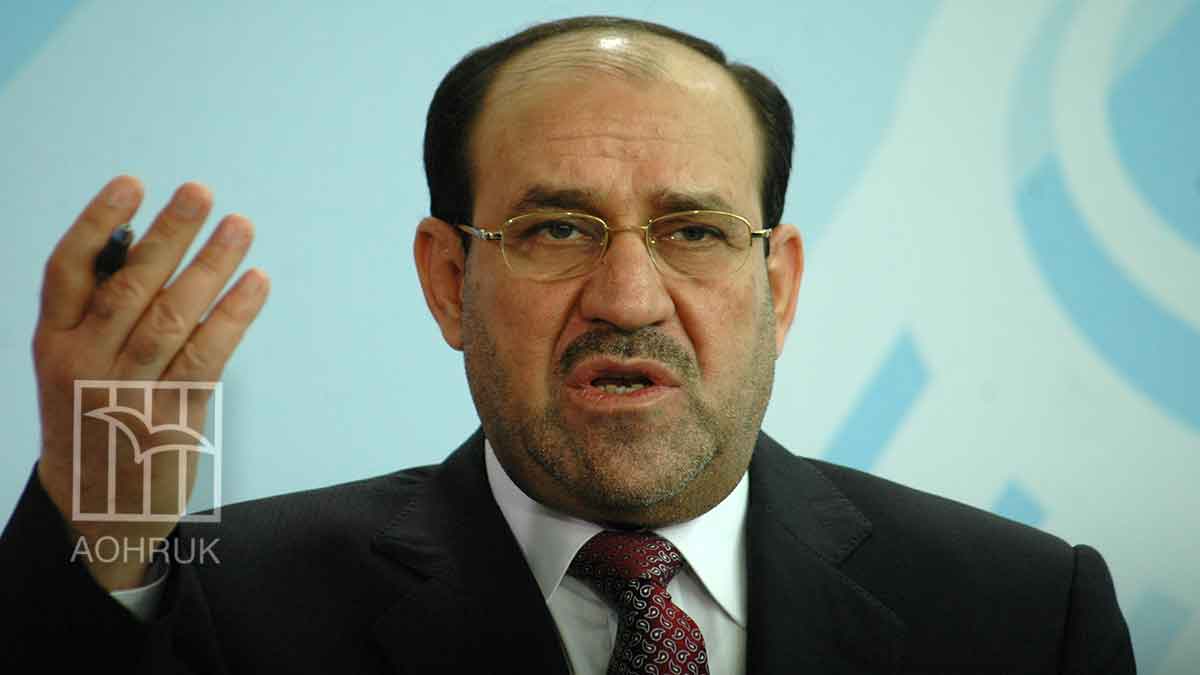
Arab Organisation for Human Rights in the UK (AOHR UK) stated that the nomination of Nouri al-Maliki for the post of Prime Minister brings back memories of dark periods marked by crimes and violations committed on sectarian grounds, as well as financial and institutional corruption that caused severe harm to the Iraqi state, tore the social fabric, and entrenched division and hatred among the people of the same nation.
AOHR UK added that during Nouri al-Maliki’s eight-year tenure as Prime Minister from 2006, and his retention of sovereign portfolios such as Defence and Interior for periods of his rule, he committed some of the most heinous crimes against the Sunni community and other components of Iraqi society. These crimes included massacres against peaceful demonstrators, large-scale forced displacement aimed at altering the demographic composition, the assassination of political figures, scholars, and military personnel, mass arrests and brutal torture, enforced disappearances, the establishment of secret detention facilities, and arbitrary trials that led to the execution of hundreds of individuals on the basis of fabricated charges.
AOHR UK explained that al-Maliki led sectarian militias under the cover of his position as Prime Minister, which were responsible for the killing of more than 137,000 civilians, including women and children, solely on the basis of their sectarian identity. Illustrating the scale of the bloodshed, from the first days of his assumption of office in May 2006 until the end of that year, more than 21,000 killings were recorded. In 2007, the number exceeded 26,000, and in the final year of his term, the number of victims surpassed 20,000, in addition to tens of thousands of wounded.
AOHR UK further noted that al-Maliki’s crimes were not limited to the Sunni community or to other components such as Christians and Yazidis, or even to those within the Shia community who disagreed with him politically.
His crimes also extended to the plundering of the country’s wealth and resources. Corruption spread across all state institutions, with billions of dollars looted under various pretexts. This included more than 6,000 infrastructure projects for which budgets estimated at 220 billion US dollars were allocated, yet none were implemented, fictitious arms contracts, the purchase of aircraft from Russia that were in fact Iraqi aircraft that had landed in Russia during the US invasion, a non-existing army that is only present on paper with salaries amounting to millions being drawn for it, the smuggling of hard currency to Lebanon and Iran, and the purchase of counterfeit explosive detection devices at a cost of millions of dollars. These and other corruption cases were documented in Iraqi parliamentary files as well as international records.
AOHR UK stressed that, despite the gravity of the crimes committed by al-Maliki and senior members of his government, they have escaped accountability. Some fled Iraq, while others remained, including al-Maliki himself, enjoying protection from Iran, the most influential external power in Iraq. Today, instead of being held to account for these crimes, he is being rewarded through his nomination for the post of Prime Minister.
AOHR UK also noted that Nouri al-Maliki’s criminal activities were not confined to Iraq. They extended to Syria, where, with the outbreak of the Syrian revolution, al-Maliki joined a Russian-Iranian alliance to support Bashar al-Assad by facilitating the passage of militias to fight alongside the Assad regime, in addition to providing funding and weapons to suppress the Syrian uprising.
AOHR UK emphasised the necessity for the Iraqi people, in all their components, to reject this nomination, and that such rejection must not be limited to any single group. The crimes committed by al-Maliki inflicted profound damage on the Iraqi state as a whole, damage from which it has yet to recover. For Iraq to move towards genuine recovery, Nouri al-Maliki and all those implicated with him must be held accountable for the crimes they committed, and the looted public funds must be recovered.
Finally, AOHR UK called on the international community to put pressure on all parties supporting al-Maliki’s nomination for the post of Prime Minister to withdraw their support and to seek an alternative figure who enjoys acceptance across all segments of society, has not been involved in crimes against civilians, and is untainted by corruption.
Al-Maliki is not an inevitable outcome of the sectarian quota system governing Iraq as there are other figures within the same political component whose records are not stained by a grave violations record like that of al-Maliki’s.