















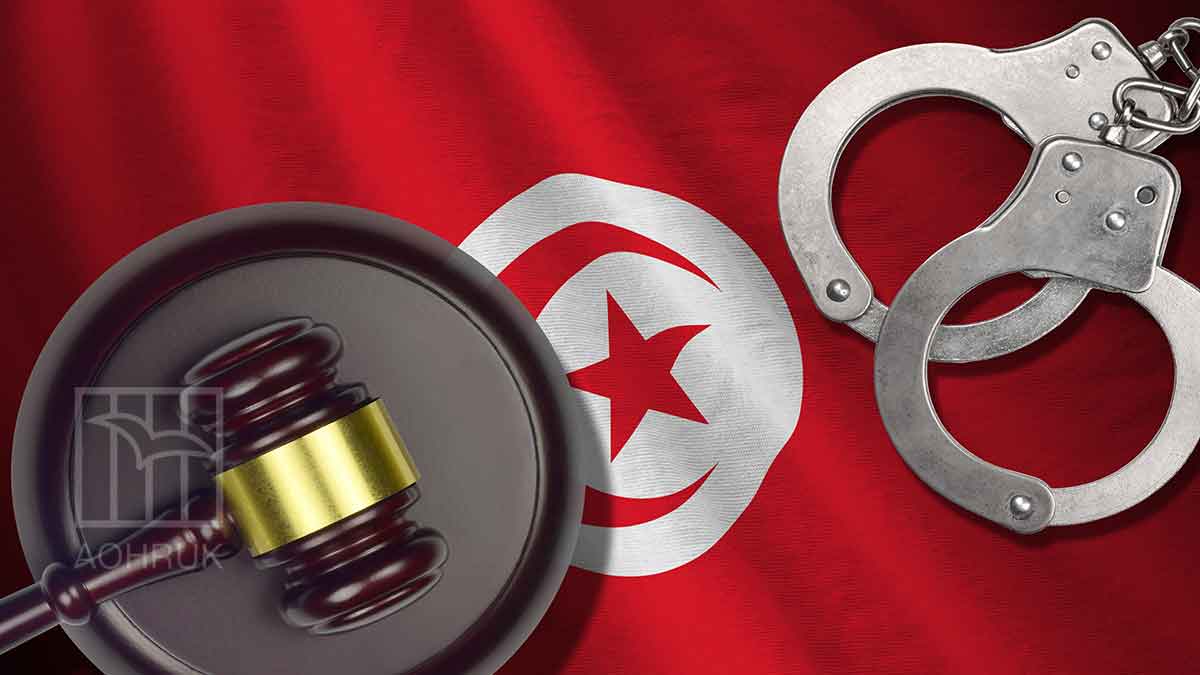
In a fresh chapter in the erosion of judicial independence and the settling of political scores, the Criminal Chamber specialising in terrorism cases at the Court of Appeal in Tunis has handed down severe sentences against former Prime Minister and Interior Minister Ali Laarayedh and a number of security and political figures in what is widely known as the “Tasfir” case. The rulings range from three to 24 years’ imprisonment, with most of those convicted also subjected to additional administrative monitoring.
The court sentenced Laarayedh to 24 years in prison, reducing an initial sentence of 34 years issued at first instance. Heavy penalties were also imposed on prominent security officials, including former head of the Aircraft Protection Unit Fathi al Baldi and Abdel Karim al Abidi, alongside Nour Eddine Qandouz, Lotfi al Hammami, Hichem Saadi and Sami al Shaar. The rulings further encompassed Seifeddine Raies, former spokesperson of the banned organisation Ansar al Sharia, with varying prison terms and administrative restrictions.
These judgments come amid the acute political tensions that have gripped Tunisia since the exceptional measures announced by President Kais Saied in July 2021. They mark a grave escalation in the use of the judiciary as a mechanism for reshaping the political landscape through extended punitive sanctions rather than through the ballot box or the ordinary course of democratic life.
The case traces back to the alleged facilitation of young Tunisians travelling to conflict zones, particularly in Syria, during 2012 and 2013. While such accusations are inherently serious under Tunisian law, the manner in which they are being adjudicated today raises fundamental concerns regarding fair trial guarantees, the presumption of innocence, and the prohibition on attributing criminal liability solely on the basis of political or security offices previously held, absent direct and conclusive evidence of specific criminal acts.
Trials conducted within a charged political climate, and amid sweeping restrictions on opposition figures, journalists and civil society activists, inevitably struggle to meet the essential standard of impartiality. Judicial independence is not a mere constitutional abstraction; it is a foundational safeguard against the courts’ transformation into instruments of executive authority. When prosecutions coincide with political and media campaigns targeting particular opponents, confidence in the integrity of proceedings is eroded and the spectre of political retribution looms large.
Moreover, the retroactive criminalisation of acts with political or administrative dimensions, or the expansive interpretation of penal provisions so as to impose liability on the basis of political affiliation or official position, runs counter to the settled principle in criminal law that prohibits broadening the scope of criminalisation by analogy. Criminal justice rests not on notions of a prevailing “political climate” or abstract “political responsibility”, but on precise and unequivocal evidence establishing both the criminal act and the causal link.
What is unfolding in Tunisia reflects a systematic trajectory towards subordinating the public sphere through the courts, transforming judicial forums into arenas for consolidating new political balances of power. Rather than addressing past failures through transparent and independent mechanisms of accountability, recourse is being had to weighty sentences that sideline adversaries and send a sweeping deterrent message to any who might contemplate dissent.
In this form, the “Tasfir” case has come to symbolise a phase in which civic space contracts and justice is reduced to an instrument of political discipline. Most troublingly, the persistence of this approach threatens to undermine what remains of public trust in state institutions, entrenching a reality in which prosecution serves to reorder the political arena rather than to uphold justice.