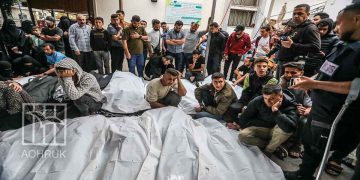

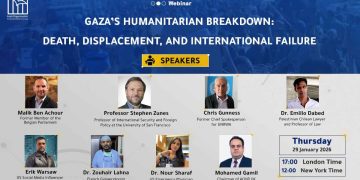


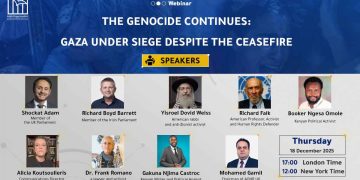


Arab Organisation for Human Rights in the UK (AOHR UK) convened a dedicated webinar to examine the continued genocide being carried out by the Israeli occupation against the Palestinian people, particularly in the Gaza Strip, despite the announcement of a ceasefire. The webinar focused on the post-ceasefire reality on the ground, where violations have not ceased, the siege and collective punishment remain in place, and the deliberate obstruction of food, medicine, and humanitarian aid continues amid an unprecedented humanitarian collapse and the ongoing targeting of civilians and the foundations of life.
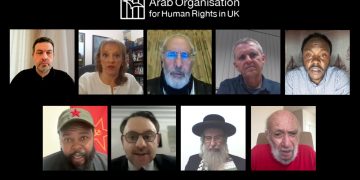
The webinar brought together a distinguished group of parliamentarians, human rights defenders, activists, and political analysts from diverse international backgrounds. The speakers included Shockat Adam, Member of the UK Parliament; Richard Boyd Barrett, Member of the Irish Parliament; Richard Falk, American professor, activist, and human rights defender; Rabbi Yisroel Dovid Weiss, American anti-Zionist activist and spokesperson for the worldwide religious group Neturei Karta; Dr. Frank Romano, international human rights activist and member of the July 2025 Gaza Freedom Flotilla (Handala); Alicia Koutsoulieris, Communications Director at Partners for Palestine; Booker Ngesa Omole, Kenyan political activist; and Gakuna Njima Castro, Kenyan writer and political analyst.
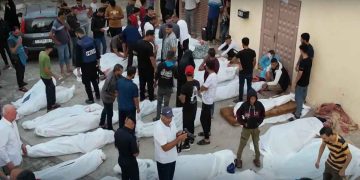
In his contribution, Irish MP Richard Boyd Barrett firmly challenged the false political narrative promoted in recent days—particularly by former U.S. President Donald Trump—claiming the existence of a peace agreement or genuine ceasefire in Gaza. He stressed that what has been presented as a ceasefire is, in reality, nothing more than a slight reduction in the intensity of massacres, while killings and injuries continue unabated. Boyd Barrett pointed to credible estimates indicating that approximately 400 Palestinians have been killed and more than 1,000 injured since the announcement of the so-called ceasefire. He underlined that Israeli occupation forces continue daily military operations, including attacks on buildings, obstruction and targeting of aid delivery efforts, repeated breaches of declared lines, and the systematic prevention of humanitarian assistance from entering Gaza, all while a catastrophic humanitarian crisis continues to unfold.
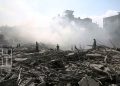
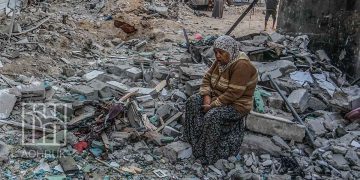
He further emphasized that Gaza was already described by the United Nations as being in a state of permanent humanitarian catastrophe even before October 2023, and that the scale of destruction since then has been unprecedented. Boyd Barrett highlighted that around 90 percent of residential buildings have been damaged or destroyed, the healthcare system has been almost entirely dismantled, and vital infrastructure—water systems, schools, universities, and institutions essential to sustaining human life—has been systematically leveled. He noted that the occupation continues to block aid that could offer even minimal relief, while floods and heavy rains have worsened conditions for displaced families living in overcrowded shelters and tents. He described the situation as one of ongoing genocidal violence, making clear that Israel is not pursuing peace but rather continuing its campaign at a slightly altered pace.
Boyd Barrett argued that the announcement of a ceasefire was not the result of diplomatic success, but the outcome of sustained Palestinian resistance and an unprecedented global uprising that has exposed the reality of Israel’s genocidal project. He stressed that Palestinians have refused to be ethnically cleansed despite the scale of violence inflicted upon them, while mass mobilization across the world has increasingly discredited the Israeli regime and pressured Western governments that have armed, enabled, and politically shielded it. In his final remarks, Boyd Barrett issued a clear call to action, pointing to a sanctions bill he recently introduced in the Irish Parliament calling for the complete severing of economic, political, and diplomatic relations with Israel. He emphasized that under the Genocide Convention and international law, states are legally obligated not only to punish genocide after it occurs, but to actively prevent it. Drawing a direct comparison with apartheid South Africa, he called for the full international isolation of Israel as the only viable path toward ending the occupation, halting the genocide, and securing genuine self-determination for the Palestinian people.
In his intervention, Richard Falk described the current moment as one of “fake diplomacy,” arguing that recent political maneuvers have deliberately diverted media and international attention away from Israel’s ongoing abusive policies toward the people of occupied Palestine, and Gaza in particular. He stated that while the level of aerial bombardment and artillery fire may have slightly decreased, Palestinians in Gaza remain in a condition of total vulnerability, subjected to repeated Israeli attacks that fundamentally negate any claim that a genuine ceasefire or pathway to peace exists. Falk stressed that what is being presented as diplomacy is instead a continuation of violence by other means, serving Israel’s long-standing objective of erasing Palestine rather than ending the assault.
Falk emphasized that Israel’s actions must be understood within a broader ideological project aimed at annexation and Jewish supremacy, often concealed behind security rhetoric. He argued that the notion of “Greater Israel” reflects expansionist ambitions to seize as much land as possible while minimizing the Palestinian population, and that the current phase represents a shift in tactics rather than an end to genocidal policies. He further warned that winter conditions, inadequate shelter, and exposure are now causing daily Palestinian deaths, compounding the devastation inflicted by military force. Falk sharply criticized the international community—particularly the United Nations—for failing to confront this reality, describing the unanimous Security Council resolution endorsing the Trump-backed approach as a shocking act of complicity that rewards the perpetrator of genocide while punishing its victims.
In his concluding remarks, Falk framed the situation as not only a humanitarian catastrophe but a profound crisis of the international legal and moral order. He stated that Israel has become a pariah state in the eyes of the world’s peoples, yet continues to be protected and rewarded by Western powers and global institutions that claim to uphold law and justice. Drawing a stark historical analogy, he compared this dynamic to empowering surviving Nazis to shape post-war Germany. Falk highlighted the civilizational dimension of the conflict, noting that Israel’s backing comes primarily from Western states, while Palestinians are supported largely by the Global South. He concluded with a clear call to action, stressing that civil society movements worldwide must intensify resistance, solidarity, and pressure, particularly in light of the continued exclusion of Palestinians from any role in determining their own future. Until the Palestinian right to self-determination is genuinely recognized and acted upon, he warned, the region will remain in a dangerous free fall toward deeper injustice and instability.
In his remarks, Shockat Adam delivered a sharp critique of the British government’s position on Gaza, describing it as a continuous pattern of political failure that has persisted from the outset of Israel’s assault through the so-called ceasefire. He stressed that successive UK governments—and particularly the current Labour government, from which greater action had been expected—have failed to take any meaningful steps to challenge Israel’s actions. Adam noted that official statements are consistently filled with expressions of “concern” and “disturbance,” yet are entirely devoid of tangible measures, amounting to unconditional political cover for Israel while massacres of civilians continue.
He highlighted the absence of any serious accountability mechanisms, pointing out that the UK government has not even summoned the Israeli ambassador to explain inflammatory statements or ongoing violations. Adam emphasized that no economic, cultural, or diplomatic sanctions have been imposed, and recalled a parliamentary exchange in which then–Foreign Secretary David Lammy dismissed the possibility of sanctions on the grounds that they would be “too expensive.” Adam drew a direct historical parallel, warning that slavery itself was prolonged using the same justification of economic cost. He described the ceasefire as fundamentally one-sided, with Israel continuing its attacks, while aid remains severely restricted, media access is denied, and Gaza is treated as a marginal issue within Parliament—illustrated by the fact that Gaza debates have been minimized or combined with unrelated crises, despite the scale of devastation.
Turning to the West Bank, Adam described conditions as “absolutely atrocious,” citing the killing of more than 1,000 Palestinians since the escalation began and hundreds more injured in recent months, including foreign nationals. Drawing on his own visit to the West Bank earlier in the year, he spoke of entire towns being sealed off without explanation, mass displacement from refugee camps, and routine violence against civilians. He stressed that every aspect of Palestinian life—education, religion, culture, and even food—is under sustained attack, and warned that parliamentary efforts to raise these issues are routinely met with dismissive responses that conceal inaction behind hollow rhetoric.
In the final part of his intervention, Adam addressed the treatment of hunger strikers and broader civil liberties in the UK, warning that repression is now extending beyond Palestine to those who stand in solidarity with it. He condemned the reaction of some parliamentarians who laughed when the issue of hunger strikers was raised, describing it as a deeply shameful moment. Adam warned that British citizens are now facing erosion of fundamental rights, including attempts to criminalize political speech and protest. He concluded by drawing a stark connection between the destruction of Palestinian lives in Gaza and the shrinking of democratic space in the UK, stressing that while governments continue to fail, many parliamentarians and large segments of the public remain committed to resisting injustice and holding power to account.
In his intervention, Dr. Frank Romano asserted that Israel has never intended to end the war on Gaza, pointing directly to statements made by Israeli Prime Minister Benjamin Netanyahu himself, who has openly declared that the war will not stop until Israel destroys Hamas. Romano stressed that despite attempts by the United States to reframe or soften this position diplomatically, the reality is clear: Netanyahu does not intend to withdraw from Gaza or comply with a ceasefire unless he is compelled to do so. He emphasized that Israel played a central role in drafting the ceasefire proposal while simultaneously violating it, describing this behavior as consistent with a long-standing Israeli strategy of systematically breaching ceasefire agreements, including previous agreements with Lebanon.
Romano outlined the structure of the ceasefire agreement announced in mid-January, explaining that it was designed to unfold in three stages: an initial hostage exchange and humanitarian access phase, followed by a permanent ceasefire and further exchanges, and finally the release of remains and the start of reconstruction. He noted that while the first phase was partially implemented, Israel retained control over approximately 58 percent of Gaza and has since violated the agreement extensively. Romano cited documented figures indicating that Israel has breached the ceasefire hundreds of times, killing more than 400 Palestinians and injuring over a thousand others, while continuing military operations in areas it was supposed to have withdrawn from. He further highlighted that Israel currently occupies more than half of the Gaza Strip and continues to attack Palestinians even beyond the zones stipulated in the agreement.
Addressing the humanitarian dimension, Romano stressed that Israel has deliberately obstructed aid delivery in violation of the ceasefire’s explicit terms. He noted that prior to October 7, approximately 500 aid trucks entered Gaza daily, while the ceasefire agreement required 600 trucks per day. However, he pointed out that only a fraction of that aid—around 39 percent—has actually reached its intended destinations. Romano cited United Nations warnings that tens of thousands of children have been affected by winter storms while Israel continues to block essential winter supplies, exacerbating already catastrophic living conditions. He argued that this deprivation is not incidental but systematic, reinforcing Israel’s control over Gaza through humanitarian strangulation.
In analyzing why Israel continues to violate the ceasefire with apparent impunity, Romano identified direct international complicity as a central factor. He stated that continued arms transfers and political backing from countries such as the United States and Germany effectively legitimize Israel’s violations. He cited Germany’s decision to lift restrictions on arms exports to Israel under the pretext of a “stabilized ceasefire,” arguing that such actions normalize continued military aggression. Romano further explained that Israel routinely fabricates pretexts to resume attacks during ceasefires—such as unsubstantiated claims of gunfire, explosives, or alleged Hamas activity—in order to engineer the collapse of the agreement. He concluded that this pattern reflects a deliberate strategy to ensure the failure of any ceasefire, allowing Israel to maintain control over Gaza and advance its broader regional policy of territorial expansion, a strategy that will only be halted through sustained international pressure and accountability.
In his intervention, Rabbi Yisroel Dovid Weiss categorically rejected Israel’s attempts to cloak its crimes against Palestinians in religious justification, stressing that what is unfolding in Gaza and across occupied Palestine has nothing to do with Judaism. He described Israel’s actions as a sustained campaign of dehumanization, noting that beyond bombardment and direct killing, Palestinians are being subjected to psychological destruction through deliberate exposure to freezing winter conditions, flooding, displacement, and deprivation—conditions that are themselves lethal. Weiss emphasized that civilians are dying not only from bombs, but from cold, hunger, illness, and the systematic dismantling of the conditions necessary for survival, while the world remains largely silent.
He underscored that Israel consistently evades responsibility for its crimes by invoking selective narratives—most notably the repeated instrumentalization of October 7—to justify mass killing, torture, and collective punishment. Weiss pointed to Israel’s ongoing arrest, torture, and killing of doctors, hospital directors, and medical staff, describing these acts as clear evidence of criminal intent rather than self-defense. He stressed that Israeli officials routinely absolve themselves of accountability by framing any reaction to these atrocities as irrational or hateful, while ignoring the reality that two years of continuous killing, imprisonment, and destruction inevitably generate global outrage.
Weiss forcefully challenged the international community’s failure to confront these crimes, calling it an insult to humanity that decades of occupation, and more than two years of intensified devastation in Gaza, have been met with impunity. He rejected the conflation of Judaism with Zionism, warning that this deliberate distortion fuels hatred and shields a violent political project from accountability. In his concluding remarks, Weiss drew a direct parallel with apartheid South Africa, arguing that Israel, like the apartheid regime before it, relies on intimidation, moral blackmail, and international silence to survive. He issued a clear call to action, urging people worldwide to resist intimidation, reject false accusations used to silence criticism, and confront an occupation that has no legitimacy in law, morality, or justice, stressing that the urgency to act is now—while lives can still be saved.
In his intervention, Booker Ngesa Omole presented a political analysis from an African perspective, grounding African solidarity with the Palestinian people in a shared historical experience of settler colonialism. He emphasized that African societies, having endured colonial domination and dispossession, recognize the Palestinian struggle as part of the same global pattern of colonial violence. Omole rejected the long-standing portrayal of the Palestinian question as a religious conflict, stressing that this narrative—widely circulated through Western and corporate propaganda—has been used to obscure the reality of a settler-colonial project in which Palestinians are displaced, massacred, and then falsely labeled as terrorists.
Omole argued that the current ceasefire cannot be trusted, describing it as a tactical maneuver supported by the United States and the Western capitalist bloc rather than a genuine effort to secure peace or justice. He stated that the primary objective of the so-called ceasefire was limited to securing the release of captives, while Israel continued to block reconstruction efforts and humanitarian access, including the entry of heavy machinery needed to rebuild Gaza. He highlighted scenes of Palestinian children digging for shelter with their bare hands as stark evidence that the ceasefire has not altered the material reality of siege and destruction. Omole stressed that Israel’s actions cannot be separated from U.S. imperial strategy, arguing that the Zionist project functions as an instrument for maintaining American dominance in West Asia, where peace is acceptable only insofar as it preserves U.S. geopolitical interests.
Drawing broader historical parallels, Omole compared Israel’s policies to settler-colonial experiments in North America and Australia, where Indigenous populations were annihilated and their lands permanently seized. He warned that the same logic is being applied in Palestine through siege, forced displacement, and the denial of Palestinian sovereignty. Omole dismissed diplomatic discourse around one-state or two-state solutions as meaningless so long as Israel refuses to recognize Palestinian self-determination, maintains Gaza as an open-air prison, and pursues the mass displacement of Palestinians into neighboring countries. He concluded by reaffirming the unconditional solidarity of African progressive movements with Palestine, asserting that Palestinian liberation is inseparable from the global struggle against imperialism. Omole stressed that history will judge those who enable genocide, and expressed confidence that the Palestinian people, as an oppressed people resisting colonial domination, will ultimately prevail.
In her contribution, Alicia Koutsoulieris placed the ongoing genocide in Gaza within a longer trajectory of deliberate destruction, recalling that as early as 2012 the United Nations had warned that Gaza would become uninhabitable by 2020 if conditions did not fundamentally change. She stressed that this warning was issued years before the current phase of mass killing began, underscoring that Gaza was already subjected to a manufactured humanitarian crisis well before October 7. Koutsoulieris pointed to Amnesty International’s 2022 report designating Israel as an apartheid state, highlighting evidence that Israeli authorities used calculated formulas to determine the minimum amount of food allowed into Gaza—enough to keep people barely alive, not to live with dignity. She emphasized that the scale of destruction and death witnessed since the onset of the genocide is unprecedented in modern times and far exceeds anything most people have seen in their lifetimes.
Koutsoulieris rejected the framing of October 7 as the beginning of the violence, describing it instead as a reaction to decades of oppression imposed on Palestinians in Gaza and the occupied West Bank. While affirming that the loss of life on any side is tragic, she stressed the extreme imbalance of the violence, noting that more than 70,000 Palestinians have been killed over the course of the genocide, compared to roughly 2,000 Israelis since the conflict began. She described Israel’s actions as collective punishment, pointing to the systematic targeting of civilian sites—including refugee camps, hospitals, schools, mosques, and churches. She also highlighted that Palestine is home to longstanding Christian communities, stressing that the assault has targeted Christian lives and heritage as well, a reality often ignored in Western political discourse. Koutsoulieris further documented the scale of civilian harm, citing the killing of nearly 250 journalists, over 100 academics, more than 200 humanitarian aid workers, and close to 200 UN personnel—people whose roles were to document suffering or provide lifesaving assistance, not to engage in combat.
In her concluding remarks, Koutsoulieris outlined a clear call to action centered on education and political advocacy, particularly in the United States. She stressed that widespread ignorance about Palestine has long enabled impunity, and that social media has become a crucial tool for bypassing controlled narratives and amplifying the voices of those experiencing genocide and apartheid in real time. She urged communities to translate awareness into sustained pressure on elected officials, emphasizing that U.S. taxpayer funds—amounting to billions of dollars annually—are directly enabling Israel’s violence under the pretext of “security.” Koutsoulieris warned that unconditional political and financial support for Israel has not only devastated Palestinian society, but has also fueled harm and backlash affecting Jewish communities worldwide. She concluded by stressing that elected officials must be confronted with a clear choice: stand on the right side of history, or face accountability at the ballot box for enabling genocide and mass atrocities.
In his speech, Gakuna Njima Castro addressed the continued Israeli assault on Gaza through a political and humanitarian lens, emphasizing that the current ceasefire remains fragile, unenforced, and largely symbolic. He noted the persistence of sporadic military operations and repeated violations, arguing that these breaches reflect Israel’s continued disregard for both the ceasefire framework and the right of Palestinians to life and security. Castro stressed that the Israeli government has provided no coherent or transparent vision for Gaza’s future—whether under a one-state or two-state framework—indicating that the underlying objective remains the preservation of control rather than the pursuit of a just political resolution.
He highlighted the worsening humanitarian conditions in Gaza, particularly as winter weather has compounded the devastation caused by prolonged bombardment. Castro pointed to collapsing buildings, flooding, and displacement as consequences not only of climate conditions but of Israel’s failure to halt military actions and allow meaningful relief. He underscored that women and children are bearing the brunt of this compounded crisis, facing simultaneous military violence, political repression, and environmental exposure. He further emphasized that Israel’s continued interference with the flow of humanitarian aid—including food and medical assistance—constitutes a deliberate violation of ceasefire obligations and serves to keep the Palestinian population in a state of exhaustion and vulnerability.
Turning to the international dimension, Castro delivered a pointed critique of the United Nations, arguing that it has failed to function as a neutral guarantor or mediator due to sustained political interference. He observed that global public perception increasingly views Israel and the United States as operating in alignment, a dynamic that undermines any credible negotiation process and emboldens Israeli impunity. Castro warned that without enforceable mechanisms and genuine accountability, any ceasefire is likely to collapse, allowing Israel to consolidate its advantage and resume intensified violence. He concluded by stressing that ending the ongoing atrocities requires amplifying the voices of affected communities, empowering independent actors, and implementing firm international measures that confront Israel’s violations and affirm the Palestinian people’s right to dignity, protection, and life.